






From the Orchestra Pit to the Open Fairway
Claire MacKenzie has always been deliberate about how she spends her time. As Solutions Relationship Manager at Zodia Custody, she is fully present for clients across global markets, and brings that same discipline to her Pilates classes, her golf game, and her lifelong love of classical music.
In our latest “People. Without Compromise.”, we speak to Claire about how she manages her energy through the rejuvenating power of sport, Shostakovich, and the standing appointment with her friends she never misses – known affectionately as the Model UN Conference.
Hi Claire, what don’t you compromise on?
Sport and exercise. I’m a self-professed Pilates enthusiast, going three or four times a week without fail, and I’ve played golf and skied from childhood.
Classical music, which has been central to my life since I was a teenager.
Finally, spending time with my closest friends. I’m very protective of that time, and always make sure to schedule it in.
Pilates three to four times a week is a serious commitment. Why do you enjoy it so much?
It gives me fifty minutes of complete focus on myself, where I’m switched off from everything else. At work, I’m present and engaged in every conversation and every client call, making sure to be on good form regardless of how I feel that day, but when I’m at Pilates I don’t have to think about that. For those fifty minutes, nobody needs anything from me and that genuinely restores my energy.
When did you start doing Pilates?
I had a total hip replacement at 24 and, through physiotherapy, my recovery led me to Pilates. Before that I’d always been active – playing hockey and netball, swimming at school – but everything changed when I had my surgery as I struggled to get back into high-impact sports. Pilates started as rehabilitation but, over time, has developed into a core part of my routine and reinvigorated my whole relationship with exercise.
Golf and skiing are also on your list. Have you always done both?
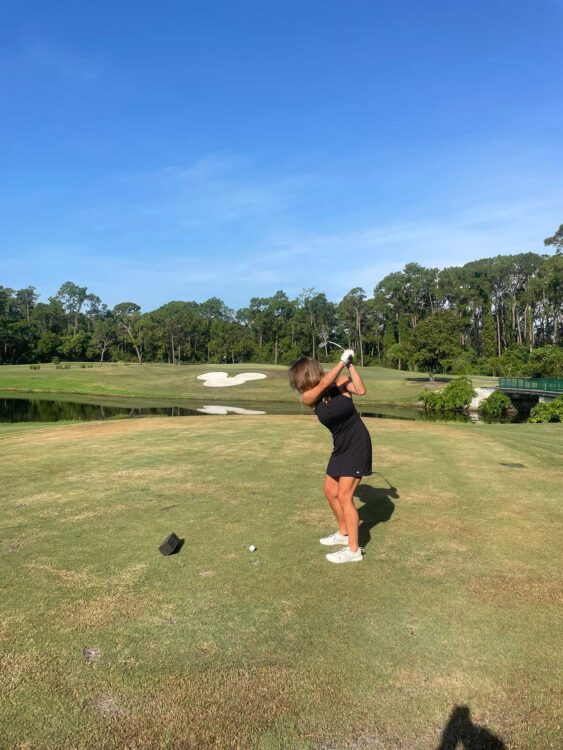
I’ve been skiing and playing golf since childhood, both activities my father and I bonded over when I was growing up.
With golf, I’ve always loved the fact that you spend three or four hours outside, in nature, with nothing competing for your attention. When I play, I keep my phone in my bag and focus only on what’s going on in front of me, which creates some distance from the constant noise of the world and helps me switch off. There’s a particular course in Scotland, Cruden Bay, that I come back to whenever I can. It’s a links course set on the dunes and cliffs of the Aberdeenshire coast, and at one point you play off a cliff directly down onto the beach. It truly feels like I’m stepping away from the world, from work, and getting a chance to mentally reset.
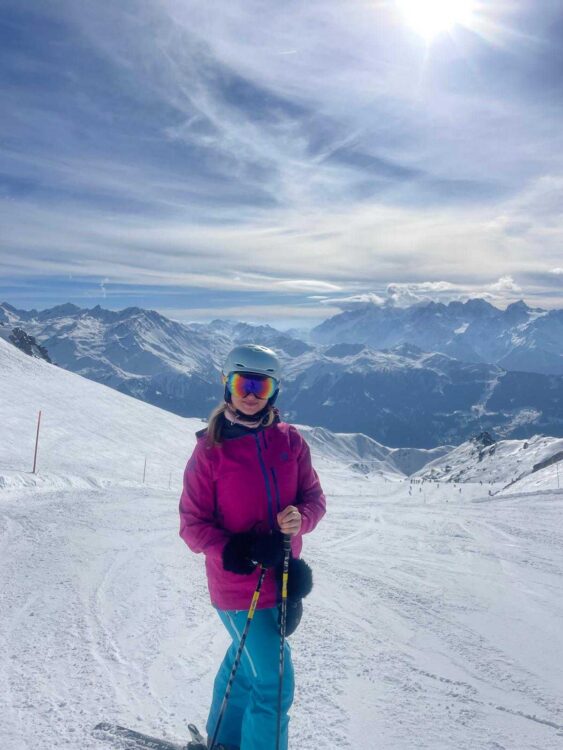
Skiing gives me the same feeling of stepping away from the world. Outside, surrounded by mountains, and the only focus is what’s going on in front of you. When you’re moving down a slope at speed the world gets very simple very quickly – you have to stay focused and make decisions in a split second to make sure you get to the bottom safely. There’s no room for distractions.
You also mentioned a love for classical music. Is there a particular instrument you play?
I play the French horn and piano, originally picking up the French horn because it looked cool, which perhaps was not the most considered reason!
After I reached Grade 8, I realised there was so much more I could do and whole new world of music and performance opened up. I ended up playing Principal Horn in the National Children’s Orchestra of Scotland, and by the time I was at university music was my primary focus outside of my studies. I was the UCL Music Society president, taking part in pit bands for musicals, and playing in semi-professional orchestras.
I think I was drawn in by the late Romantics – Tchaikovsky, Shostakovich, Brahms. That era of music makes you feel its weight and emotion, and the French horn sits at the heart of that sound, which is why I love playing it.
Do you still play?
Not currently. A friend regularly lets me know of ensembles that need French Horns, but the concerts are reliably scheduled for the weeks I’m usually away! It’s also a big commitment, with a fixed schedule of rehearsals over weekends and in the evenings, which is not easy to fit around life and work.
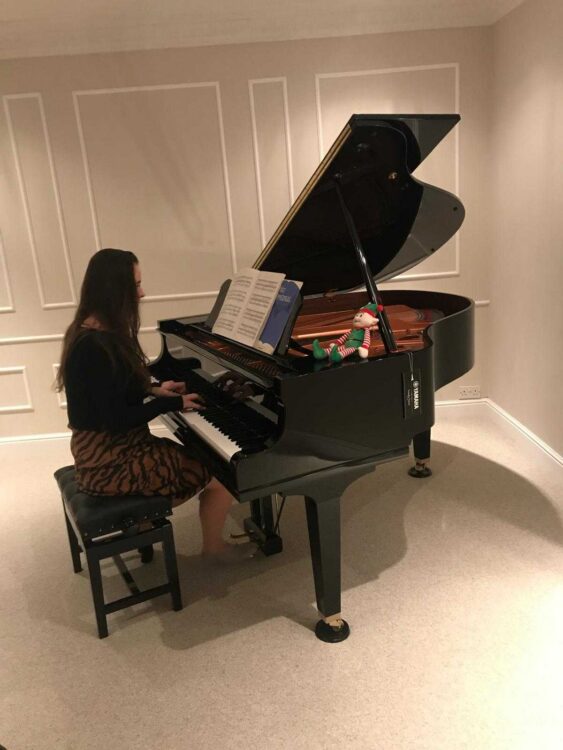
I still listen constantly, though, because I have an enduring love for the music. There’s a richness and depth to classical music, particularly when you hear it played live by a full orchestra, that draws you in. You get the full emotional range, from grief to triumph, sometimes within the same movement and then when you understand the context in which something was written – like Shostakovich composing under a Soviet regime, embedding dissent into music that had to appear patriotic on the surface – the emotional complexity builds and takes over. This type of music also teaches you something about how complex and emotionally layered humans are, and that there is always something going on under surface, which can be helpful when your role is client facing.
You mentioned that time with your closest friends is also as non-negotiable as sport or music. What makes it so important to protect?
My role centres on building relationships with people all over the world and that’s an element I truly love about it, but it takes energy to do well. I have to find ways to replenish that energy, and spending time with my closest friends is where I do that most naturally. It’s a completely different kind of connection to anything at work – uncomplicated and joyful. Getting to spend quality time together recharges the energy I need to carry me through at work and do my best for our clients.
How often do you spend that time together?
The three of us have had a standing date in the diary once a week for years, and somewhere along the way it acquired a name: the Model UN Conference. The discipline of protecting that time matters as much as the time itself, and we treat it as a fixture rather than something that moves when work gets busy. It is the same as Pilates, in a way. As long as I protect the things that restore my energy outside of work, it means I can keep giving and delivering at work.
Share article:
Stay up-to-date
Sign up for the latest news, research and events from Zodia.

Get in touch
Our friendly team is always here to chat